
A Comparison of Feasible Energy-Saving Retrofit Alternatives for Office Buildings in Urban Cities
DOI:
https://doi.org/10.56532/mjsat.v5i4.524Keywords:
VRF, Energy conservation, building Insulation, Polyurethane, Payback PeriodAbstract
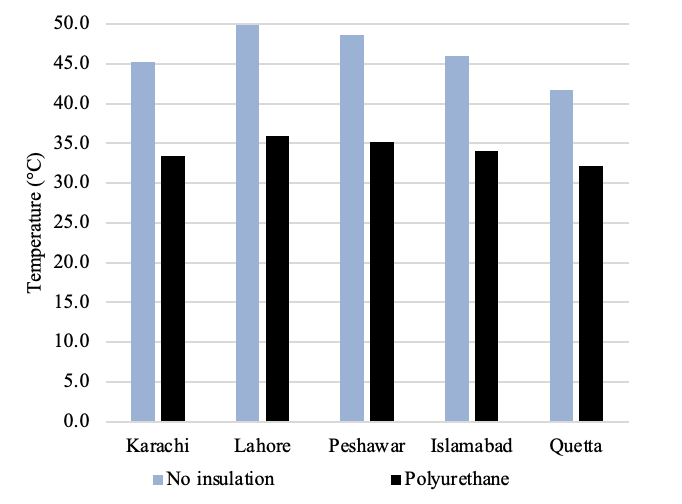
The major portion of the world population lives in cities and consumes around 73% of world total energy. Due to rapid rise in population, improved standard of living, urbanization and major time spend indoor, the energy consumption in buildings has skyrocketed during the past few decades. The primary portion of building's energy consumption is utilized by HVAC system. Energy crisis is worsening day by day, especially in underdeveloped countries like Pakistan. In this research work, a SketchUp model of a single zone building is created, and it is subsequently loaded into the Energy plus program to simulate the model and ascertain the trends in energy use for the chosen cities in various scenarios for five major cities of Pakistan. Without insulation the zone temperature can reach upto 45.2 °C, 49.9 °C, 48.6 °C, 46 °C and 41.7 °C for Karachi, Lahore, Peshawar, Islamabad and Quetta respectively which is reduced by 22 – 28 % by applying insulation. For Peshawar, Karachi, Quetta and Islamabad highest energy consumption was reported in the month of July, May, July and June respectively. The energy saving is increased by 5 – 26 % by replacing conventional air conditioner with VRF AC without insulation and by 32 – 70 % by applying insulation with VRF AC as compared to VRF AC without insulation. The payback period ranges between 28 – 60, 19 – 42, 16 – 35, 18 – 39 and 21 – 45 months for Quetta, Karachi, Lahore, Peshawar and Islamabad respectively. The longest PBP of 92 months is reported for Quetta at 5% tariff and 60% investment cost increase with VRF air conditioner, while the lowest PBP of 16 months is recorded for Lahore at 15% tariff and 20% investment cost increase with combined installation of insulation and VRF air conditioner.
References
Jeon, J., Lee, J. H., Seo, J., Jeong, S. G., & Kim, S. (2013). Application of PCM thermal energy storage system to reduce building energy consumption. Journal of thermal analysis and calorimetry, 111, 279-288. doi: https://doi.org/10.1007/s10973-012-2291-9
Saha, S., Ruslan, A. R. M., Monjur Morshed, A. K. M., & Hasanuzzaman, M. (2021). Global prospects and challenges of latent heat thermal energy storage: A review. Clean Technologies and Environmental Policy, 23, 531-559. doi: https://doi.org/10.1007/s10098-020-01997-7
Berardi, U. (2017). A cross-country comparison of the building energy consumptions and their trends. Resources, Conservation and Recycling, 123, 230-241. doi: https://doi.org/10.1016/j.resconrec.2016.03.014
Harish, V. S. K. V., & Kumar, A. (2016). A review on modeling and simulation of building energy systems. Renewable and sustainable energy reviews, 56, 1272-1292. doi: https://doi.org/10.1016/j.rser.2015.12.040
Allen, K., Connelly, K., Rutherford, P., & Wu, Y. (2017). Smart windows—Dynamic control of building energy performance. Energy and Buildings, 139, 535-546. doi: https://doi.org/10.1016/j.enbuild.2016.12.093
Li, D. H. W., Lam, J. C., & Wong, S. L. (2002). Daylighting and its implications to overall thermal transfer value (OTTV) determinations. Energy, 27(11), 991-1008. doi: https://doi.org/10.1016/S0360-5442(02)00067-1
Xue, Z., & Jiang, Y. (2004). Energy consumption and energy saving potential analysis for large-scale public buildings in Beijing. Heating Ventilating & Air Conditioning, 34(9), 8-10.
Galvin, R. (2010). Thermal upgrades of existing homes in Germany: The building code, subsidies, and economic efficiency. Energy and Buildings, 42(6), 834-844. doi: https://doi.org/10.1016/j.enbuild.2009.12.004
Creyts, J. C. (2007). Reducing US greenhouse gas emissions: how much at what cost?: US Greenhouse Gas Abatement Mapping Initiative. McKinsey & Company.
Kumar, Dileep, et al. "Comparative analysis of building insulation material properties and performance." Renewable and Sustainable Energy Reviews 131 (2020): 110038. doi: https://doi.org/10.1016/j.rser.2020.110038
Aditya, Lisa, et al. "A review on insulation materials for energy conservation in buildings." Renewable and sustainable energy reviews 73 (2017): 1352-1365. doi: https://doi.org/10.1016/j.rser.2017.02.034
Lee, Junghun, et al. "Impact of external insulation and internal thermal density upon energy consumption of buildings in a temperate climate with four distinct seasons." Renewable and Sustainable Energy Reviews 75 (2017): 1081-1088. doi: https://doi.org/10.1016/j.rser.2016.11.087
Akram, M. Washim, et al. "Global technological advancement and challenges of glazed window, facade system and vertical greenery-based energy savings in buildings: A comprehensive review." Energy and Built Environment 4.2 (2023): 206-226.. doi: https://doi.org/10.1016/j.enbenv.2021.11.003
Shaikh, Hamza, et al. "The impact of the wall insulation material and variable refrigerant flow system on building energy consumption and cost." Journal of Mechanical Engineering and Sciences (2023): 9383-9394. doi: https://doi.org/10.15282/jmes.17.1.2023.8.0742
Ascione, Fabrizio, et al. "Building envelope design: Multi-objective optimization to minimize energy consumption, global cost and thermal discomfort. Application to different Italian climatic zones." Energy 174 (2019): 359-374. doi: https://doi.org/10.1016/j.energy.2019.02.182
Farghali, Mohamed, et al. "Strategies to save energy in the context of the energy crisis: a review." Environmental Chemistry Letters 21.4 (2023): 2003-2039. doi: https://doi.org/10.1007/s10311-023-01591-5
Heidari, A., & Olivieri, F. (2023). Energy Efficiency in Dome Structures: An Examination of Thermal Performance in Iranian Architecture. Buildings, 13(9), 2171. doi: https://doi.org/10.3390/buildings13092171
Farghali, Mohamed, et al. "Strategies to save energy in the context of the energy crisis: a review." Environmental Chemistry Letters 21.4 (2023): 2003-2039. doi: https://doi.org/10.1007/s10311-023-01591-5
Yurtseven, M. Berker, et al. "An experimental investigation of energy saving potentials for room type variable-speed air conditioners in public offices: A case study from Istanbul." Energy and buildings 68 (2014): 165-171. doi: https://doi.org/10.1016/j.enbuild.2013.09.020
Atallah, G., & Tarlochan, F. (2021). Comparison between variable and constant refrigerant flow air conditioning systems in arid climate: Life cycle cost analysis and energy savings. Sustainability, 13(18), 10374. doi: https://doi.org/10.3390/su131810374
Kim, D., Cox, S. J., Cho, H., & Im, P. (2017). Evaluation of energy savings potential of variable refrigerant flow (VRF) from variable air volume (VAV) in the US climate locations. Energy Reports, 3, 85-93. doi: https://doi.org/10.1016/j.egyr.2017.05.002
Aynur, T. N. (2010). Variable refrigerant flow systems: A review. Energy and Buildings, 42(7), 1106-1112. doi: https://doi.org/10.1016/j.enbuild.2010.01.024
Downloads
Published
Issue
Section
License
Copyright (c) 2025 Hamza Shaikh, Rizwan Ahmed Memon, Shoukat Ali Noonari, Asad Shaikh, Abdul Hameed`` Soomro, Ali Murad Jokhio

This work is licensed under a Creative Commons Attribution-NonCommercial 4.0 International License.

