
Assessment of a Modular Solar-Powered Cooling System Integrated with a DC-Remote Monitoring and Control System for Fruits and Vegetables Storage
DOI:
https://doi.org/10.56532/mjsat.v5i4.536Keywords:
Modular , Solar Cooling, Remote Monitoring, Tomato StorageAbstract
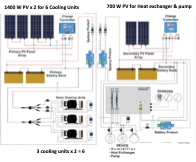
This study examines the applicability of solar energy for cooling in the tropical climate and focuses on the performance assessment of a modular solar-powered cooling system (MSPCS), integrated with a DC-Remote monitoring and control (RMC) system, installed on a 10 m³ cooling chamber for the storage of fruits and vegetables. The RMC capability to stabilise the MSPCS operation was assessed through real-time monitoring and control of system parameters, including temperature and relative humidity, water chiller temperature, and DC voltage utilisation by the components. This was achieved by connecting sensors for monitoring via an internet-enabled data box linked to a PC dashboard. The system cooling performance was assessed by measuring chamber temperature, humidity, voltage consumption and weight loss of the stored produce. The results demonstrated effective tracking/control of the system parameters and enhanced activation of components to stabilize the operation of the entire cooling system at temperature of (8.40 ±0.455a °C), relative humidity of (88.91 ±1.571 %) inside the cooling chamber, the water chiller temperature at (2.75 ±1.25 °C) and system voltage (25.61±0.033 V) at no-load and loading conditions. The integration of the DC-RMC system significantly enhanced both the cooling chamber's thermal performance and the overall voltage efficiency of the system, resulting in 20% physiological weight loss and a delay in ripening by 10 days for stored tomatoes in the solar cold room as against 75 % and 7 days, respectively from the ambient over 14 days. of storage.
References
Adebiyi, A. O., Ogunbiyi, O. A., Gbabe, E. K., Idris, Y. D., Adeiza, A. & Omodara, M. A. (2023). Solar Cooling: A Sustainable Technology for Reducing Postharvest Losses in Fruits in Nigeria. Book of Abstracts of the 4th All-Africa Postharvest Congress and Exhibition (Hybrid). Held at the African Union Commission, Addis Ababa, Ethiopia. 19 - 22. September 2023. Pp 77.
Concepcion, R., Janairo, A. G., Palconit, M. G., Carpio, J., Bandala, A., Vicerra, R. R., Cuello, J., & Dadios, E. (2021). Influence of Storage Periods and Temperatures on Postharvest Quality of Fresh-Marketed Lycopersicon esculentum Mill. 2021 IEEE 13th International Conference on Humanoid, Nanotechnology, Information Technology, Communication and Control, Environment, and Management, HNICEM 2021, pp. 1–6. doi: https://doi.org/10.1109/HNICEM54116.2021.9731896.
FAO. (2022). Sustainable food cold chains: Opportunities, challenges and the way forward. In Sustainable food cold chains: Opportunities, challenges and the way forward. doi: https://doi.org/10.4060/cc0923en.
Jain, S., & Paul, S. (2020). Advances in Intelligent Systems and Computing 1124 Recent Trends in Image and Signal Processing in Computer Vision. http://www.springer.com/series/11156 doi: https://doi.org/10.1007/978-981-15-2740-1.
Khiro, H. A. Al, & Boukhanouf, R. (2024). Energy and Exergy Performance Analysis of Solar-Assisted Thermo-Mechanical Vapor Compression Cooling System doi: https://doi.org/10.3390/su16198625.
Mashayamombe, T., Mhlanga, S., Muusha, P., & Muusha, N. (2023). Design of a Remote Monitoring System for Solar Thermal Energy: A Case Study in an Educational Institution. International Journal of Research Publication and Reviews, 4(11), pp. 2436–2445. doi: https://doi.org/10.55248/gengpi.4.1123.113130.
Ogumo, E. O., Kunyanga, C. N., Kimenju, J. W., & Okoth, M. (2020). Performance of a fabricated solar-powered vapour compression cooler in maintaining post-harvest quality of French beans in Kenya. African Journal of Food Science, 14(7), pp. 192–200. doi: https://doi.org/10.5897/AJFS2020.1968.
Olosunde, W. A., Aremu, A. K., & Onwude, D. I. (2016). Development of a Solar Powered Evaporative Cooling Storage System for Tropical Fruits and Vegetables. Journal of Food Processing and Preservation, 40(2), pp. 279–290. doi: https://doi.org/10.1111/jfpp.12605.
Sambo, B. E., Ahmed, A., Omotugba, J. T., Adedapo, J. O., & Shekwolo, G. (2016). The Challenge of Infrastructure Development on Preservation of Perishable Horticultural Produce for Sustained Urban Food Nutrition in Metropolitan Kaduna, Nigeria. International Journal of Horticulture and Forestry Research, 1(1), pp. 13–26. doi: https://eajournals.org/ijhfr/vol-1issue-1-march-2015.
Shao, D., Venkitasamy, C., Li, X., Pan, Z., Shi, J., Wang, B., Teh, H. E., & McHugh, T. H. (2015). Thermal and storage characteristics of tomato seed oil. Lwt, 63(1), 191–197. doi: https://doi.org/10.1016/j.lwt.2015.03.010.
Sinha, A., & Karale, S. R. (2013). A review on Solar Powered Refrigeration and the Various Cooling Thermal Energy Storage (CTES) Systems. International Journal of Engineering Research & Technology (IJERT), 2(2), 1–14. id: IJERTV2IS2198. www.ijert.org.
Takeshima, H., Yamauchi, F., Edeh, H. O., & Hernandez, M. A. (2023). Solar-powered cold-storage and agrifood market Modernization in Nigeria. Agricultural Economics (United Kingdom), 54(2), 234–255. doi: https://doi.org/10.1111/agec.12771.
Thole, V., Vain, P., & Martin, C. (2021). Effect of Elevated Temperature on Tomato Post-Harvest Properties. Mdpi.Com/Journal/Plants, 10(10), 2359. https://doi.org/10.3390/plants10112359.
Verploegen, E., Ekka, R., Gill, G., & Faso, B. (2019). A Research Report of Evaporative Cooling For Improved Fruit & Vegetable Storage In Rwanda & Burkina Faso. MITD-Lab, May 2019.
Yadav, R. K. (2020). Remote Monitoring System for Cold Storage Warehouse using IOT. International Journal for Research in Applied Science and Engineering Technology, 8(5), 2810–2814. doi: https://doi.org/10.22214/ijraset.2020.5473.
Sibanda, S. (2021). Development Of A Solar-Powered Indirect Air Cooling Combined With a Direct Evaporative Cooling System For Storage Of Fruits And Vegetables In Sub-Saharan Africa. doi: https://doi.Org/10.13140/Rg.2.2.13604.60808.
Munir, A., Ashraf, T., Amjad, W., Ghafoor, A., Rehman, S., Malik, A. U., Hensel, O., Sultan, M., & Morosuk, T. (2021). Solar-Hybrid Cold Energy Storage System Coupled with Cooling Pads Backup : A Step towards Decentralized Storage of Perishables. Energies, 14(22), 7633. MDPI, pp. 2–20. doi: https://doi.org/https://doi.org/10.3390/en14227633.
Babarinsa, F. A., & Omodara, M. A. (2016). Preservation of Tomatoes in a Brick-Walled Evaporative Cooler Journal of Postharvest Technology jpht, 4(1), pp. 1–5. link:
Saad, A., & Jaiswal, P. (2014). Non-destructive quality evaluation of intact tomato using VIS-NIR spectroscopy. International Journal of Advanced Research (2014), 2(12) pp. 632-639 l
Ishaque, F., Hossain, A., Sarker, A. R., & Rahman, H. (2019). A Study on Low-Cost Post-Harvest Storage Techniques to Extend the Shelf Life of Citrus Fruits and Vegetables. 9(1), pp. 1–17. doi: https://doi.org/10.9734/JERR/2019/v9i117009.
Zakari, M. D., Abubakar, Y. S., Muhammad, Y. B., Shanono, N. J., Nasidi, N. M., Abubakar, M. S., Lawan, I., & Ahmad, R. K. (2016). Design and Construction of an Evaporative Cooling System for the Storage of Fresh Tomatoes. ARPN Journal of Engineering and Applied Sciences, 11(4), pp. 2340–2348.
Downloads
Published
Issue
Section
License
Copyright (c) 2025 Adebayo Adebiyi, Musiliu Sunmonu, Michael Odewole, Michael Omodara, Engineer

This work is licensed under a Creative Commons Attribution-NonCommercial 4.0 International License.

